

Why Narrow Forks on a Pallet Jack Solve Aisle Width, Not Capacity
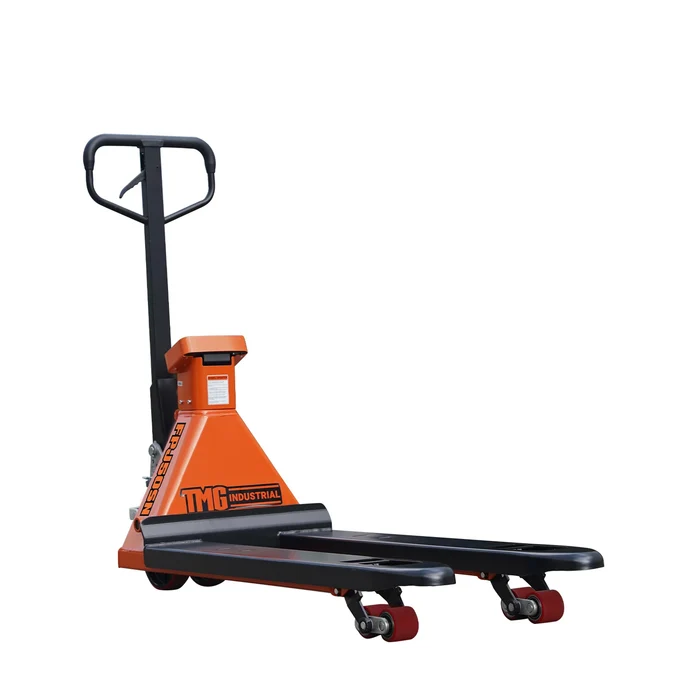
A pallet jack is compared on capacity, and capacity is rarely what stops one. Five thousand pounds covers almost everything a stockroom moves. What stops a truck is a doorway, a turn at the end of a rack, or a trailer with pallets loaded crossways. A narrow pallet jack truck with scale is built around those constraints rather than around weight.
Where a standard pallet jack stops fitting
Standard forks sit around twenty seven inches across the pair, which matches a North American pallet entered from the short side. That width is fine until the pallet is a half size, a drum skid, or something built on site to no standard at all.
It is also too wide for a lot of older buildings. Doorways, lift cars and the gap between a rack leg and a wall were sized before pallet handling was universal, and a truck that cannot pass through them is parked.
Fork length is a separate decision
A forty five inch fork is shorter than the common forty eight inch pallet, which sounds like a disadvantage and often is not. Shorter forks turn inside a tighter radius and stop short of what is stacked behind the pallet being moved.
The trade is support. A pallet carried on forks that reach only part way is held at the entry end and cantilevered at the far end, which is acceptable for a well built pallet and not for a tired one.
Steering angle decides the turning footprint
A truck that steers through two hundred and ten degrees can swing the handle past ninety and keep pulling. That matters in a confined aisle, because the operator can position the body of the truck in line with the load rather than beside it.
The practical result is a turn made in roughly the length of the truck instead of a three point shuffle. In a trailer, where the working width is a little over eight feet and the load has to come straight out, that difference decides whether the last pallet can be reached at all.
Weighing at the point of handling
A scale built into the forks moves the weighing operation to where the load already is. The alternative is a floor scale, which means handling each pallet twice and finding floor space for the scale itself.
Accuracy is the question to ask. A pallet truck scale is typically specified within a fraction of a percent of capacity rather than within a fixed number of pounds, so the absolute error on a light load is smaller than people assume and the reading on a very light load is proportionally less reliable.
Getting a usable reading
Four habits cover most of it:
- Lift clear of the floor, then let it settle
- Zero the scale with the forks empty
- Keep the load roughly centered on the forks
- Check the truck is level before reading
The last one matters on a sloped loading dock. A scale measures hydraulic pressure in the lift circuit, and on a slope part of the load is being carried by the floor through the rear wheels rather than by the forks.
What wears out and what that costs
The load wheels do most of the work and take most of the abuse, especially crossing dock plates and expansion joints. Polyurethane tires are quieter and easier on finished floors, nylon rolls more easily over debris, and the choice is really about the floor rather than the load.
The pump seal is the other consumable. A truck that lowers slowly under load is usually telling you about a seal rather than a leak, and it is worth attending to before the day it will not hold a pallet at all.
Entering a pallet that is already damaged
A broken deck board is the most common reason a lift goes wrong, and it is almost always visible before the forks go in. The entry end takes the abuse, so a quick look along that edge costs nothing and catches most of it.
Loading a pallet truck against a damaged stringer concentrates the whole weight onto one fork rather than two. The pallet usually survives the lift and fails during the turn, which is the worst moment for it because the load is already moving sideways.
Choosing against the building rather than the load
Capacity, fork length and overall width are all on the specification sheet. The numbers that decide whether a truck works are the narrowest doorway it must pass, the tightest turn it must make, and the smallest pallet it must pick up.
TMG Industrial builds this one at five thousand pounds with forty five inch forks, narrow spacing, a built in scale and steering through two hundred and ten degrees. Measuring the building before comparing capacities is what prevents a perfectly capable truck from sitting unused in a corner.