

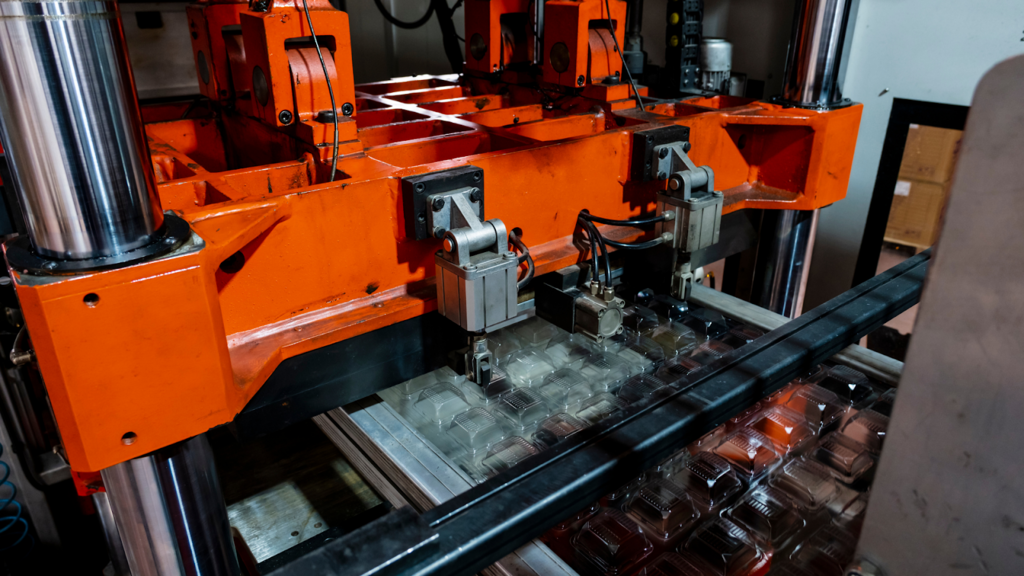
Imagine walking into your plant in 2027 and seeing forming stations that tune heater zones by themselves, spot defects before they appear and swap between recycled and bio-based sheets with almost no stoppage.
That picture is closer than it sounds. Research already shows that thermoforming delivers strong gains in packaging performance and shelf life across food applications.
Over the next few years, the real question is not whether these changes arrive, but who is ready when they do and who gets left trying to catch up.
Why 2025 to 2030 is thermoforming’s make or break decade
The future of thermoforming is tied to hard numbers. The global thermoforming market is projected to reach approximately 12.8 billion dollars by 2025, with a 5.8 percent CAGR from 2020. That is steady, not hype driven, growth.
At the same time, brands and regulators are pushing hard on recycled content, carbon reporting and recoverable formats. On the technology side, smarter thermoforming technology is arriving fast, from in-press vision to cobots on the end of the line. Taken together, the next five years will decide which plants move ahead and which fall behind.
Many teams are already asking for practical help with choices on materials, tooling and automation. For them,Custom thermoforming support can be the difference between a risky guess and a structured roadmap tied to data, grants and clear payback.
Here are eight thermoforming trends 2025 to watch, plus simple pilots you can start without betting the whole plant.
Bio based feedstocks will move from trial to mainstream
Sustainability is shifting from side project to core spec. The global biodegradable packaging market is expected to reach 500 billion dollars by 2026, with a CAGR over 15 percent from 2021. That growth will pull thermoformers toward PLA, rPET and newer algae based options.
If you run food or personal care packaging, it is worth lining up trials with at least two bio or recycled grades this year and logging cycle time, scrap and color stability. Even a small launch gives you data when a brand buyer asks how ready you are for sustainable thermoforming. Next we shift from materials to how those lines actually run.
AI driven monitoring will quietly sit behind every profitable line
Once you start running mixed feedstocks, process stability matters a lot more. Automation in thermoforming can cut material waste by up to 30 percent when sensors and controls are added to older presses. That is serious money in resin alone.
You do not need a greenfield plant to benefit. A camera tied to a simple rules engine can flag thin corners or web wrinkles long before an operator walks past. Tools that began in automotive now fit neatly into thermoforming automation, and most vendors offer rental programs so you can prove savings on one former, then roll out.
Hybrid and multi material parts will win higher margin work
Demand is rising for trays and medical packs that combine barrier, impact strength and nice shelf presence in a single press cycle. Machines that can handle deeper draws and a wider range of sheet thickness saw demand grow by 8 percent in recent years. Buyers clearly like flexible kit.
If you quote for chilled food, pharma or high value hardware, it could be time to review equipment specs and tool design rules with that in mind. A line that can move from simple PET trays to coextruded structures without a full refit gives you more ways to say yes to complex RFQs. With material and structure options growing, where production happens also starts to shift.
Smaller, closer micro factories will nibble at long distance supply
Shorter lead times and lower freight emissions are attractive to brands under pressure on service and carbon. A compact forming cell placed near a major customer can hit both. Some converters are already running pilot cells in spare warehouse space at key accounts, rather than shipping finished packs across borders.
If your customers complain about shipping delays, it may be worth modelling a small satellite cell tied back to your main plant for tool and maintenance support. A simple comparison of freight cost, response time and local energy prices will tell you if the idea is worth a deeper look. Once your geography is more flexible, part design becomes the next big lever.
Generative design will cut resin use and tooling risk
Many firms still design trays and blisters in the same way they did a decade ago. That is changing fast as generative design tools become easier to run. Early users report 20 to 40 percent material savings on some thermoformed parts when ribbing and wall thickness are tuned by software rather than guesswork.
You do not have to switch your whole CAD stack. Start by sending a single high volume part to a partner who knows generative design for thermoforming tools and ask them to show you a lighter version that still survives your standard drop and crush tests. If the math looks good, you can decide whether to build in house skills. Design is not the only place where rules are getting tighter though.
EPR rules will make mixed materials a last resort
Extended producer responsibility schemes are spreading, and many of them penalise packs that are hard to sort and recycle. It seems that mixed PET and PVC blisters will become more costly in fees as countries specify clearer design for recycling rules. That hits thermoformers that still rely on black or multi layer structures that MRFs cannot handle.
A simple first move is to sit with your three biggest customers and map each pack against current recycling guidelines in their main markets. Often a shift to a single polymer, or at least to detectable colours and inks, avoids future fees and keeps you ahead of retailer scorecards. Once those basics are covered, attention turns to full carbon reporting.
Carbon accounting will decide who gets invited to bid
Brand owners are already asking for the carbon footprint of thermoformed packaging in RFQs, not just price and spec. To answer with any confidence, you need decent data on resin mix, energy and scrap. The good news is that most of this can be pulled from systems you already have if you get IT and plant teams talking.
Even a simple model that shows carbon per thousand trays from cradle to gate will put you ahead of many rivals. Over time, you can plug LCA tools into your ERP so every run carries its own footprint. That level of reporting makes it easier to defend margins when buyers push hard on cost. Of course, none of this matters if there are not enough people to run the lines.
Cobots will become the standard way to plug labor gaps
Finding and keeping skilled operators is not getting easier. Automation can enhance production speeds by up to 50 percent while decreasing labor costs by nearly 30 percent, according to one industry study on plastics plants. Collaborative robots are a big part of that story.
They are well suited to stacking, packing and even some inspection work at the end of thermoforming technology lines. A small trial cell on your highest volume SKU is usually enough to test cycle times, safety and worker acceptance. If it works, you can add more units without ripping out existing presses or conveyors, which makes cobots a gentle but powerful path into broader thermoforming automation.
Common questions about thermoforming’s future
Will bioplastics actually reach cost parity?
They are not there yet, but gap is closing as volumes grow and oil prices swing. When you add savings on EPR fees and the chance to win new contracts that demand greener options, small price differences can still make sense.
Can older lines handle smarter monitoring tools?
In many cases, yes. Most modern cameras and sensors can talk to older PLCs with the right gateway. Even if you cannot close the loop automatically, simple alerting and dashboards still cut scrap and save maintenance time.
Are recycled thermoforms really being recycled?
In regions with strong sorting kit, clear PET trays perform fairly well, but mixed or dark formats usually do not. That is why many teams are switching to clear, mono material designs that match what MRFs can actually sort and sell.
Final thoughts on the future of thermoforming
Taken together, these eight thermoforming predictions show a sector that is getting smarter, cleaner and closer to customers, rather than simply bigger. Plants that move early on materials, data and flexible automation will gain a head start that is hard to match. Those that wait may still catch up, but at a higher cost and under more pressure. Perhaps the most useful step now is simply to pick one area and run a low risk pilot that proves what is possible.